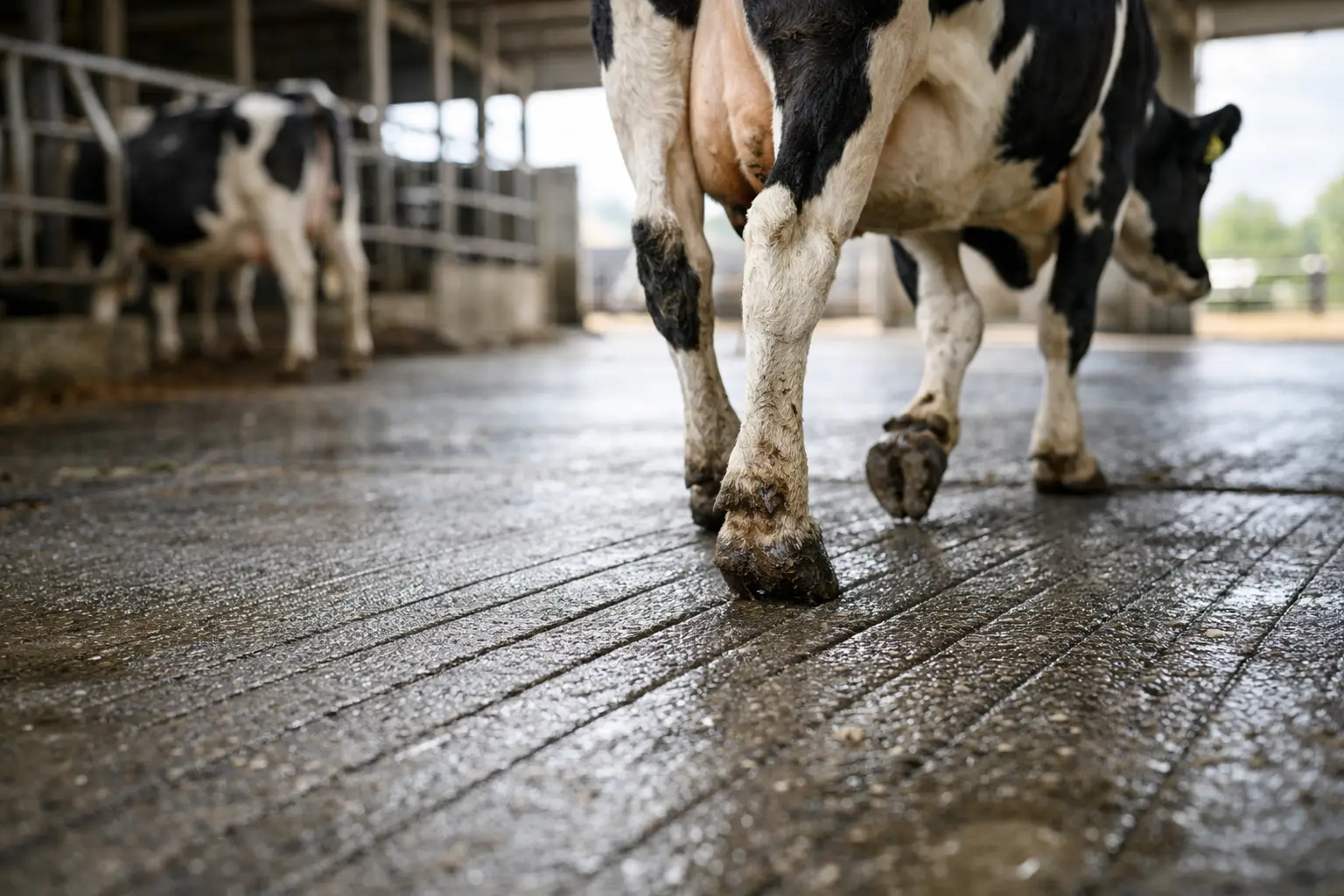
A cow that hesitates at the dairy entry, shuffles around a corner, or spreads her weight awkwardly on a wet race is telling you something about the floor. If you need to improve cattle traction on concrete, the issue is rarely just surface grip on its own. It usually comes back to how that concrete handles moisture, manure, traffic volume, hoof wear and the way stock actually move through the shed.
Slippery concrete costs more than the odd near miss. It contributes to falls, knocks confidence in the herd, increases stress during movement, and can add to hoof damage and lameness over time. For dairy, beef and mixed livestock operations, better traction is a farm safety job and a productivity job at the same time.
Why cattle lose grip on concrete
Concrete becomes dangerous for stock when the top surface turns smooth, polished or contaminated. That can happen gradually in high-traffic areas such as dairy yards, feed pads, collecting pens, laneways and entry points where hooves pass over the same ground every day. Even concrete that started with a reasonable finish can wear down under constant use.
Water, effluent and fats make the problem worse. A surface that seems acceptable when dry can become slick once it is wet. Add slope, sharp turns or pressure from backing gates, and cattle start compensating. They shorten stride, brace through the shoulders, and put extra strain on feet and legs.
There is also a balance to get right. Too smooth and cattle slip. Too aggressive and the surface can be hard on hooves. Good traction is not about creating a rough floor at any cost. It is about producing a texture that gives reliable hoof purchase without causing unnecessary wear.
The best way to improve cattle traction on concrete
In most farm settings, the most effective way to improve cattle traction on concrete is to change the surface profile rather than rely on temporary fixes. Professional concrete grooving and bush hammering are the main options because they alter the surface in a controlled, durable way.
Grooving cuts patterned channels into the concrete to improve grip and help move water and effluent away from the contact area. It works well where cattle travel in regular directions and where slip risk increases in wet conditions. Bush hammering creates a more uniformly textured finish by mechanically roughening the top layer of the slab. This is often suited to areas where multi-directional movement matters, such as holding yards or spaces where animals turn, bunch or pivot.
Which method suits best depends on the site. A straight dairy exit and a busy yard corner do not behave the same way under stock traffic. The right recommendation comes from looking at how cattle use the space, how much moisture sits on the slab, and whether the concrete itself is still structurally sound.
Grooving for grip and drainage
Concrete grooving is often the first choice where slip risk is linked to wet traffic lanes. The grooves create edges that help hooves bite into the surface, while also reducing the film of slurry or water that sits underfoot. That combination is what makes grooving especially useful in dairies and other high-throughput livestock areas.
Done properly, grooving is precise work. Depth, spacing and layout all matter. If the pattern is wrong for the class of livestock or the movement path, the result can be underwhelming or too harsh. That is why generic cutting methods are not enough on working farms. Livestock concrete needs to be treated as livestock infrastructure, not just another slab.
Bush hammering for broader surface texture
Bush hammering is a strong option where concrete has become polished over a wider area and cattle need grip in more than one direction. Instead of cutting channels, the process textures the full surface to create a more consistent non-slip finish.
This can be especially useful in collecting yards, waiting areas and other points where stock are turning and shifting position rather than simply walking in a straight line. The benefit is more even traction across the slab. The trade-off is that not every area needs this level of texturing, so the treatment should match the purpose of the space.
Surface grip is only part of the answer
If a slab is wet all the time, even a better texture may not solve the whole problem. Drainage and cleaning play a major role in traction. Water pooling in low spots, poor fall, blocked channels or waste build-up can quickly turn a decent floor into a risky one.
That is why any proper traction assessment should also look at slope, runoff and washdown patterns. In some sheds, the concrete finish is the main issue. In others, the bigger problem is that moisture has nowhere to go. The safest surfaces combine texture with effective drainage so hooves meet concrete, not a slick layer sitting on top of it.
Cleaning routines matter too. Regular scraping and washdown help, but over-washing without good drainage can keep the slab wet for longer. The goal is not just a clean surface. It is a surface that stays workable under real farm conditions.
Where traction problems usually show up first
Most farms do not need every concrete area treated the same way. Some zones wear faster and carry more risk than others. Entry and exit points to the dairy are common trouble spots because cattle bunch, hesitate and accelerate there. Yard corners are another weak point, especially when animals are pushed through quickly.
Feed pads and loafing areas can also become slick if manure, water and feed residue build up over a polished slab. Races and laneways near sheds often show wear where stock funnel into narrower paths. If cattle are slipping in one location but not another, that difference usually points to a combination of traffic pattern, contamination and surface wear.
Targeting those areas first often gives the quickest return. It reduces the highest slip risk without unnecessarily treating concrete that is still performing well.
When repairs need to happen before traction work
Not every slab is ready for grooving or texturing straight away. If the concrete is breaking out, scaling, cracked badly or worn beyond the top surface, repairs may need to come first. There is no value cutting traction patterns into a slab that is already failing structurally.
This is one of those it depends situations. Minor wear can often be treated successfully. More advanced damage may call for repairs, patching or partial replacement before surface treatment makes sense. A proper inspection saves money here because it stops farms spending on the wrong fix.
Timing matters on a working farm
One reason traction jobs get delayed is the worry about disruption. That is understandable. Dairy and livestock operations do not stop just because concrete needs attention. But waiting too long usually means more slips, more stress on stock and more wear in the same high-use zones.
The practical answer is planning the work around farm flow. In many cases, sections can be treated in stages or after hours to minimise interference with milking and stock movement. That is often the difference between a job that feels manageable and one that keeps getting pushed back.
For farms with tight schedules, service matters as much as the treatment itself. The job needs to be done efficiently, with the right equipment and a clear understanding of how livestock areas operate day to day.
How to judge whether your concrete is a risk
You do not need to wait for a serious fall to know there is a problem. Repeated hesitation, short stepping, drifting on corners, visible polishing and persistent wetness are all signs the surface is not doing its job. Hoof issues can also point back to flooring, especially when they show up alongside poor confidence on concrete.
A lot of operators get used to seeing cattle move cautiously and assume that is normal on hard surfaces. It is not something to ignore. Good concrete should support steady, confident movement. If cattle are choosing every step, the floor is already affecting behaviour.
That is where a specialist eye helps. A farm concrete assessment should look beyond the obvious and consider stock class, traffic direction, cleaning systems, drainage and the age of the slab. Companies such as Happy Hoof approach this as a livestock safety and performance issue, not a generic construction task.
Improve cattle traction on concrete for the long term
Short-term measures have their place, but lasting traction comes from treating the surface properly and maintaining it over time. Concrete does not stay in ideal condition forever under stock, machinery, moisture and effluent. What works now may need attention again as traffic patterns and wear continue.
The better approach is to think in terms of long-term flooring performance. That means choosing the right treatment for each area, fixing drainage problems where needed, repairing damaged sections before they worsen, and checking high-traffic zones before they become dangerous.
When cattle can walk confidently, everything works better. Movement is calmer, handling is safer, and the floor starts supporting hoof health instead of working against it. If your concrete is making stock cautious, now is the right time to deal with it properly.