If cattle are slipping on the dairy shed approach or baulking at a wet yard, the concrete surface is usually part of the problem. When farmers compare concrete grooving vs bush hammering, they are really asking a more practical question: which finish gives reliable grip, protects hoof health, and keeps the yard working under daily farm pressure?
The answer depends on where the concrete is, how stock move across it, how much moisture is involved, and what condition the slab is already in. Both methods are designed to improve traction, but they do it in different ways and suit different farm situations.
What concrete grooving actually does
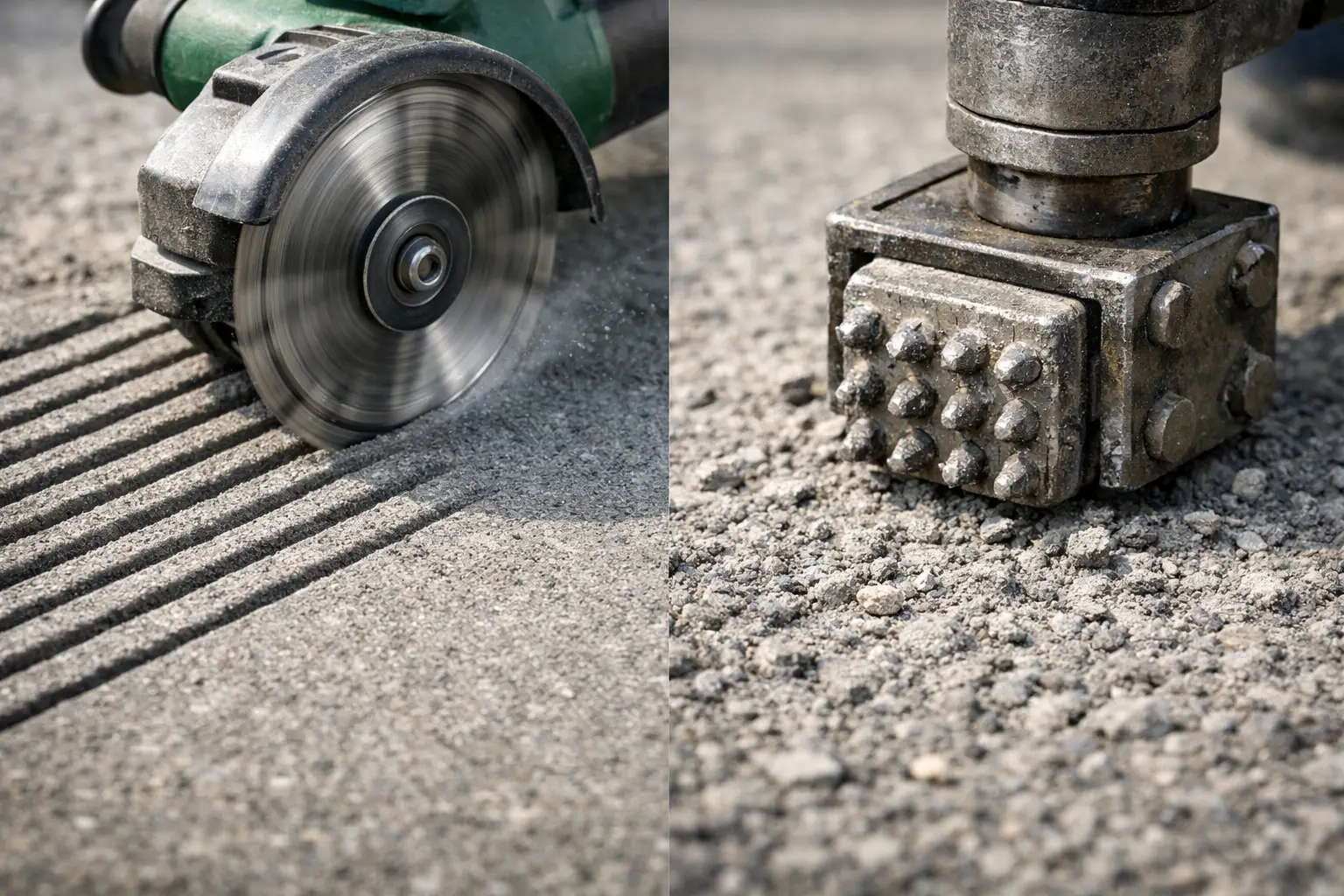
Concrete grooving cuts patterned channels into the slab. Those grooves create edges for hooves to grip, help water move off the surface, and reduce the smoothness that causes slips in high-traffic areas. On farms, grooving is commonly used in dairy yards, feed pads, race entries, shed exits, holding areas and other places where stock are moving regularly over wet concrete.
A well-grooved surface is not just about stopping falls. It also supports more confident movement. Cows that trust the surface tend to walk more freely, bunch less, and place less strain on joints and hooves. Over time, that matters. Poor footing can contribute to bruising, stress, and lameness-related losses that cost far more than the surface treatment itself.
The main strength of grooving is control. The spacing, depth and pattern can be matched to livestock type, traffic flow and drainage needs. That makes it a strong option where traction has to be consistent and predictable.
What bush hammering does on farm concrete
Bush hammering roughens the surface by mechanically texturing the top layer of concrete. Instead of cutting channels, it creates a more evenly pitted finish across the slab. This removes the polished or glazed top and gives hooves and boots more bite underfoot.
Bush hammering is often useful where the slab has become slick over time but does not need a full grooved pattern. It can suit areas where broad surface roughness is enough to restore grip, especially on older concrete that has worn smooth from traffic, effluent, washdown and general farm use.
One of its advantages is coverage. Bush hammering can treat a wide area with a uniform finish and can be a practical solution when the issue is surface polish rather than drainage or directional movement. It can also work well where grooving may be too aggressive or not ideal for the slab condition.
Concrete grooving vs bush hammering for traction
This is where the difference becomes clearer. Grooving creates defined grip points. Bush hammering creates general roughness. Both improve slip resistance, but not in exactly the same way.
In wet, high-pressure livestock areas, grooving often gives stronger long-term traction because the channels actively interrupt water film and give hooves a clear pattern to bite into. That can be especially valuable on dairy farms, where cows are moving in groups through yards and sheds several times a day.
Bush hammering improves traction as well, but it tends to rely on the roughened surface rather than a cut pattern. In the right area, that can be enough. In heavily trafficked zones where manure, water and repeated turning are constant, it may not deliver the same level of directional grip as a properly designed grooved finish.
So if the question is which method is more aggressive for traction, grooving usually wins. If the question is which method can restore grip across a worn slab without introducing channels, bush hammering has a clear place.
Hoof health matters more than just slip resistance
Farm flooring decisions should never stop at whether stock stay upright. A surface can be rough enough to reduce slipping but still be wrong for hoof wear, comfort or movement if it is poorly matched to the job.
Grooving, when done correctly, supports hoof stability without turning the whole slab into an abrasive surface. That balance matters in areas with regular livestock flow. You want enough texture for grip, but not a finish that creates unnecessary stress through constant contact.
Bush hammering can be effective, but the result depends heavily on how aggressively the surface is treated and where it is used. Too light, and the slab may stay slick when wet. Too harsh, and the texture may be harder on hooves over time, particularly in areas of prolonged standing. That is why site-specific assessment matters more than choosing a method on name alone.
Drainage and manure handling change the decision
On a working farm, surface texture and drainage go together. If water, washdown or effluent sits on the slab, slip risk rises fast. This is one reason grooving is often preferred in operational livestock areas. The grooves can assist surface water movement and reduce the slick layer that develops on smooth concrete.
Bush hammering improves grip on the top of the slab, but it does not shape water flow in the same way. If drainage is already poor, roughening the surface may help, but it will not solve the underlying problem on its own.
That does not make bush hammering the wrong choice. It just means it works best where drainage is already reasonable, or where the goal is to restore surface traction rather than manage runoff across the slab.
Which option suits older concrete?
Older concrete often needs a closer look before any treatment is chosen. If the slab is structurally sound but polished smooth from years of use, either method may be possible. If the concrete is cracked, fretting, scaling or already weakened, the best outcome may involve repairs before surface texturing starts.
Grooving requires the slab to be in suitable condition for cutting. Bush hammering also needs care, because roughening a poor surface can expose or worsen existing weakness. In practical terms, the right question is not just grooving or bush hammering. It is whether the slab can handle the treatment and still perform well after it.
This is where specialist advice matters. Farm concrete is not the same as general commercial paving. It deals with stock pressure, moisture, acids, machinery and constant wear. A treatment that looks fine on day one is not much use if it breaks down under real farm conditions.
Best fit by farm area
For dairy yards, collecting areas, shed exits and high-traffic walkways, grooving is often the stronger option because these spaces need dependable grip, predictable hoof contact and better management of wet conditions.
For older slabs that have become slick across a broad area, bush hammering can be a practical way to restore surface traction without cutting groove lines. It may also suit selected zones where stock movement is less concentrated or where a roughened finish is the more appropriate treatment.
Feed pads, raceways, holding areas and drafting zones can go either way depending on stock numbers, turning pressure, drainage, and how long animals stand in one place. There is no one-size-fits-all answer. The best result usually comes from looking at how the area is used every day, not just how it looks when empty.
Cost, downtime and long-term value
Most farmers are not comparing these methods out of curiosity. They want to know what will last, what will reduce risk, and what will avoid another job in a few years.
Grooving can offer stronger long-term value in the right areas because it is purpose-built for livestock traction and repeated wet use. Bush hammering can also be cost-effective where the surface issue is widespread smoothness and the slab suits that type of treatment.
Downtime matters as well. On busy farms, concrete work has to fit around milking, stock flow and daily routines. The right contractor should be able to assess not just the surface, but the operational pressure on the site and how to minimise disruption while still doing the job properly. That is especially important where after-hours work can keep the farm moving.
So which one should you choose?
If your main concern is slip risk in wet, high-traffic livestock areas, concrete grooving is often the better fit. It gives defined traction, supports drainage, and suits the daily movement patterns seen on dairy, beef and sheep operations.
If the slab has become generally slick and needs broad surface roughness restored, bush hammering may be the more practical option. It can improve grip effectively where a uniformly textured surface is enough and the slab condition supports it.
For many farms, the real answer is not choosing a favourite method. It is choosing the right treatment for each area. A shed exit has different demands from a holding pen. A feed pad behaves differently from a race crossing. Treating all concrete the same is usually where problems start.
At Happy Hoof, that is why surface recommendations are based on livestock safety, hoof health and how the yard actually works day to day. Good concrete should do more than look tidy. It should help stock move with confidence, reduce avoidable injuries, and keep the farm operating without the flooring becoming the weak point.
If your concrete is slippery, polished, or causing hesitation in stock movement, the most useful next step is not guessing between two methods. It is getting the surface looked at properly, because the right finish pays for itself every time animals walk across it without stress or slips.