A cattle race can look sound from the gate, yet still create risk every time stock put weight on it. Smooth, worn or poorly drained concrete causes hesitation, slipping and rushing, particularly when cattle are wet, pressured or moving through a tight section. Choosing the best concrete finishes for cattle races is therefore not just a maintenance decision. It is a practical investment in calmer stock movement, safer handling and healthier feet.
The right finish depends on the age and condition of the slab, the slope, how water leaves the race, the class of stock and the level of daily traffic. A finish that works well in a covered dairy exit may not suit an exposed beef yard that receives heavy rain and mud. The aim is consistent, reliable traction without creating a surface so aggressive that it wears hooves unnecessarily.
What a cattle race surface needs to do
Concrete in a cattle race has a demanding job. It must give animals enough purchase to walk confidently, hold up to manure, grit, effluent and machinery, and remain manageable to clean. It also needs to support the people working around stock. A slippery race can turn routine drafting, loading or treatment work into an avoidable safety issue.
Texture alone is not the full answer. Water pooling in low spots, a badly formed crossfall, damaged joints and loose aggregate can defeat even a well-textured finish. Before specifying a treatment, inspect how the surface behaves during and after washing or rain. Look for polished travel lines, puddles, areas where cattle sidestep, and chipped or broken sections around gates, troughs and turning points.
For most working races, a deliberately textured concrete surface is preferable to smooth trowelled concrete. The texture must be even and purposeful. Random roughness can leave sharp high points, trap muck and make cleaning harder, while a polished surface loses grip when wet.
Best concrete finishes for cattle races
Grooved concrete for controlled traction
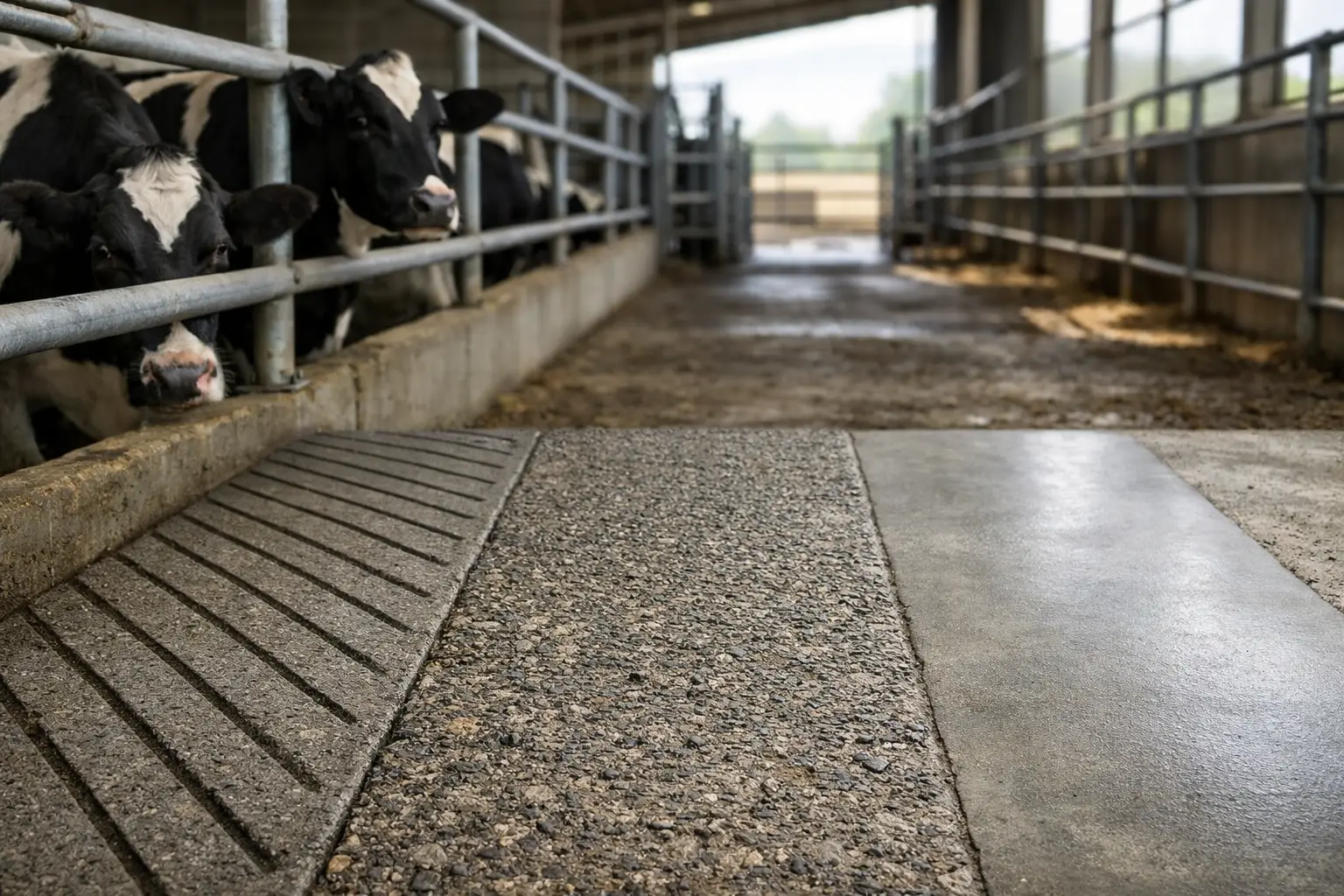
Concrete grooving is often the strongest all-round choice for existing cattle races with sound slabs. Cut grooves create defined edges for the hoof to grip, improving confidence on wet concrete without coating the surface or significantly changing its level.
Grooves are particularly effective on long straight runs, slopes, race entrances and high-pressure areas near yards and handling facilities. Their performance comes from consistency. Correct spacing, width and depth need to suit cattle movement and the condition of the concrete, rather than being treated as a one-size-fits-all pattern.
There is a balance to strike. Grooves cut too shallow may offer limited improvement once the race is wet. Grooves that are too deep, too wide or poorly laid out can be harder to clean and may create an unnecessarily harsh travel surface. Professional cutting also avoids the uneven finish and slab damage that can occur with improvised methods.
For many farms, grooving is the sensible option when the concrete is structurally sound but has become slick through age, wear and repeated washing. It targets the traction problem while retaining the strength of the existing race.
Bush hammered concrete for broad surface grip
Bush hammering is a mechanical treatment that roughens the face of existing concrete across the full travel area. Rather than relying on individual cut lines, it creates a more uniformly textured finish with broad contact under the hoof.
This can suit races where the concrete has become highly polished, particularly in turning zones and wide holding areas where cattle approach the surface from different angles. It is also useful where a continuous textured surface is preferred over grooves.
The key consideration is finish control. Bush hammering needs to be carried out evenly so the surface improves grip without becoming overly abrasive. An aggressive finish may increase hoof wear, make wash-down less efficient and shorten the useful life of a surface exposed to hard traffic. The best result is a firm, grippy texture that allows cattle to move naturally rather than cautiously.
Broomed finishes for new concrete work
A broom finish is created while fresh concrete is being placed, drawing a textured pattern across the surface before it cures. It is a practical option for new race construction, slab extensions and replacement panels, provided the concrete is correctly placed, drained and cured.
For cattle races, the direction of the broom texture matters. Texture should be planned around the expected direction of travel and the site layout, not applied as a generic finishing step. A well-executed broomed surface offers initial traction, but it can soften with wear in high-traffic zones. It is generally more suitable for new work than for solving a slippery older slab.
A broom finish also requires careful attention to drainage. No surface texture can compensate for a race that holds water, effluent or wash-down residue. Build in the right fall from the start, and make sure channels and outlets are capable of carrying water away.
Exposed aggregate where durability is the priority
Exposed aggregate can provide excellent grip and wear resistance, especially in heavy-use outdoor areas. By washing back the surface paste to reveal selected stone, the finish creates a hard, naturally textured travel surface.
However, it is not automatically the best choice for every cattle race. Aggregate size, exposure depth and stone shape must be selected carefully. Large or sharp aggregate can be uncomfortable underfoot and difficult to clean, while an inconsistent finish can develop weak spots. It is usually best considered for purpose-built yards, high-wear approaches or areas with good drainage, rather than assumed to be the answer for every livestock lane.
Where animal welfare is the priority, a controlled texture on sound concrete is often easier to tailor than an exposed aggregate surface. The right choice comes down to stock numbers, traffic patterns, cleaning practices and the level of wear expected over time.
Match the finish to the race, not just the concrete
The best finish for one section of a farm may be the wrong one 20 metres away. A steep exit race needs more traction than a level holding area. A covered lane may remain relatively dry, while an outdoor race beside a wash-down point can stay wet for much of the day. Cattle also change their movement depending on whether they are walking quietly to pasture, being drafted, or moving through a narrow race towards a crush.
Start with the highest-risk points: slopes, corners, gateways, water trough surrounds, drafting areas and the sections where cattle bunch or stop. These are often where polishing, slurry build-up and hoof slip show up first. Treating these areas may deliver a stronger return than applying the same finish across a large area with low traffic.
If the slab is cracked, spalled or sinking, surface treatment alone may not be enough. Repairs should come first so the finished race has a stable base and no broken edges that can catch a hoof. Likewise, poor drainage needs correcting alongside any traction treatment. Water travelling across a textured surface is still water underfoot.
Avoid finishes that create a new problem
Smooth steel-trowelled concrete has little place in a working cattle race. It may look tidy when new, but it becomes hazardous once water, manure or algae are present. Decorative sealers and glossy coatings are also unsuitable where stock need dependable grip.
At the other end of the scale, avoid treating roughness as a measure of safety. Very coarse surfaces can contribute to excessive hoof wear and make cleaning difficult. They may also become more problematic as the concrete ages and high points break down.
A good livestock finish is not the roughest one. It is the one that remains predictable under wet hooves, cleans up properly and supports steady movement day after day. That requires a proper look at the concrete, drainage and stock flow before work begins.
Plan installation around farm operations
Race work should fit around the farm wherever possible. Stock movements, milking times, feed-outs and weather all affect when a surface can be prepared and treated. For busy operations, after-hours or night concrete grooving can reduce disruption while still allowing the work to be completed carefully.
Preparation matters as much as the finish itself. Concrete should be cleaned so the operator can assess its true condition, with loose material and failed sections addressed beforehand. After treatment, keep the area clear until it is ready for use and introduce stock calmly. Watch how they move through the race over the following days. Confident, even steps are a useful sign that the surface is doing its job.
Happy Hoof approaches cattle race surfaces as part of the wider handling system, not as an isolated concrete job. The practical question is always the same: will this finish help stock move safely, protect their hooves and keep the farm working without unnecessary interruptions?
A race does not need to be perfect to become safer. Start with the places where cattle lose confidence underfoot, fix drainage and damage before they worsen, and choose a finish designed for the way your stock actually move. Small surface improvements in the right locations can make every pass through the yards calmer and safer.