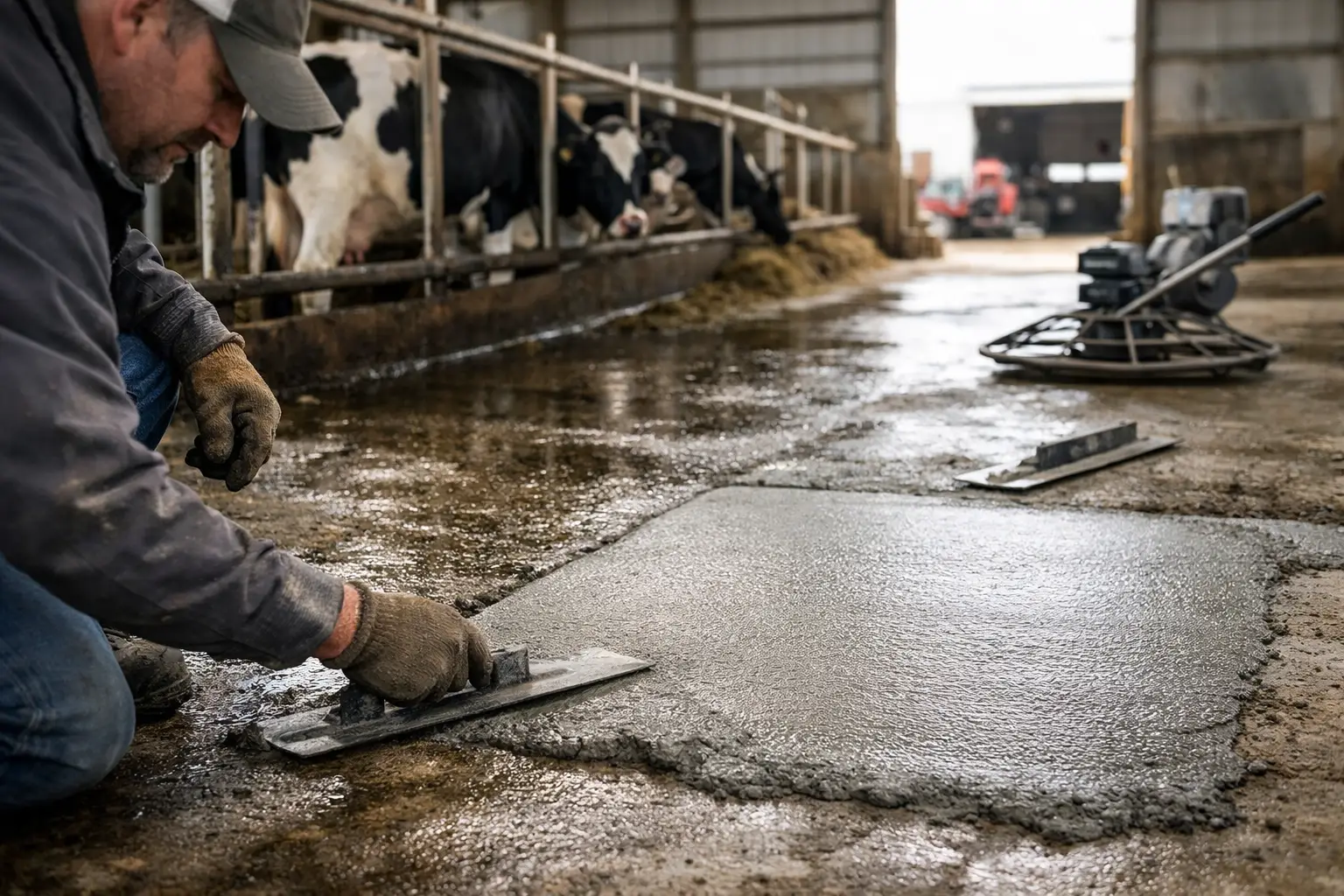
A cow losing her footing at the dairy shed entrance is not just a bad moment. It is often the first visible sign that the concrete is no longer doing its job. When surfaces polish over, pond water, hold effluent or break down under traffic, the risk shifts from occasional slips to ongoing hoof stress, lameness and lost confidence through key movement areas. That is where farm concrete repair for slippery areas matters – not as a cosmetic fix, but as a practical investment in stock flow, safety and day-to-day performance.
On working farms, slippery concrete rarely comes down to one issue alone. It is usually a mix of wear, moisture, traffic pressure, drainage faults and a surface profile that no longer gives animals enough grip. The right repair approach depends on what has changed, where it has changed, and how that area is used every day.
Why slippery concrete becomes a farm problem so quickly
Concrete on farms works harder than concrete in most commercial settings. It carries repeated hoof traffic, machinery, washdown water, manure, feed residue and seasonal weather swings. In high-use spots such as holding yards, feed pads, dairy entries and exits, races and laneways, the top surface gradually smooths off. Once that texture is gone, traction drops fast.
For livestock, that loss of grip affects more than movement. Slippery footing changes stride length, causes hesitation and puts extra stress on joints and hooves. Animals start compensating before they actually fall. You may notice bunching at corners, slower movement into the shed, shortened steps on slopes or more frequent slips around wet patches. Those are operational warning signs, not just animal behaviour.
There is also the human risk. Staff moving cattle through a slick yard, hosing down a dairy or working around a feed area are exposed to the same surface problem. One poor patch of concrete can create a pressure point for the whole system.
Farm concrete repair for slippery areas starts with diagnosis
A proper repair job starts by identifying why the area is slippery now, rather than assuming every surface needs the same treatment. Some slabs are structurally sound but too smooth. Others have cracking, scaling, rutting or poor falls that leave standing water. In many cases, repairing texture without fixing drainage only solves half the problem.
This is why inspection matters. A specialist will look at traffic patterns, moisture load, slope, contamination build-up and how the area is cleaned. A dairy collecting yard has different demands from a beef yard or sheep handling area. Even within the same farm, the best repair option may vary from one zone to the next.
If the concrete is solid and the issue is mainly surface polish, a mechanical texturing method can often restore grip effectively. If the slab is breaking away, delaminating or holding water because falls are wrong, more substantial repair work may be needed first.
What repair methods actually work
The most effective repairs for slippery farm concrete are the ones that match livestock use, drainage conditions and the remaining life of the slab. There is no single best method for every farm.
Concrete grooving
Grooving is one of the most reliable ways to improve traction in livestock areas. Cut correctly, grooves provide a consistent pattern that helps hooves grip and release naturally rather than skating across a polished face. This is especially useful in dairy sheds, collecting yards, feed pads and races where repeated movement follows predictable lines.
The quality of the cut matters. Groove spacing, depth and layout need to suit the stock class and the operating area. Poorly planned grooving can be too aggressive, too shallow or inconsistent, which limits the benefit and may increase wear.
Bush hammering
Bush hammering roughens the concrete surface by mechanically impacting the top layer and creating a more textured finish. It can be a strong option where broad surface grip is needed, particularly on areas that have become smooth but do not require a grooved pattern. It also works well when the goal is to break up a polished surface over a wider zone.
That said, bush hammering is not automatically the answer everywhere. In areas with severe contamination build-up or existing surface damage, it may need to be combined with other repair work to deliver a lasting result.
Patch repairs and slab remediation
Where concrete has chipped, cracked, spalled or broken down, traction repair alone will not be enough. Damaged sections often need to be cut out, rebuilt or patched with materials suited to the environment and traffic load. If edges are failing around drains or transitions, those details must be repaired properly or they become slip hazards of their own.
This is where generic concrete patching often falls short on farms. Repairs need to stand up to washdown, slurry, hooves and machinery, not just fill a hole.
Drainage and fall corrections
Sometimes the slipperiest part of a yard is really a drainage problem wearing a traction problem. If water and effluent sit on the surface, even a well-textured slab can become hazardous. Reworking falls, improving runoff paths or repairing blocked drainage points can make a major difference to safety and surface life.
Where repairs matter most
Not every square metre of concrete on a farm carries the same level of risk. Priority areas are usually the places where animals turn, bunch, slow down or transition between surfaces. Dairy shed entries and exits are common problem points because cattle are moving with purpose, often on wet concrete. Holding yards and collecting areas also take heavy wear and constant moisture.
Feed pads are another high-risk zone, especially where feed residue and manure combine with smooth surfaces. Ramps and sloped approaches deserve close attention because even a slight grade becomes more dangerous when texture wears away. Around troughs, gateways and corners, repeated pivoting can polish the concrete quickly.
When budgets need to be staged, these high-pressure areas are the smart place to start. Fixing the worst traffic points first often delivers a noticeable improvement in stock confidence and movement.
Repair now or replace later?
This depends on how much slab life is left and whether the current layout still works for the farm. In many cases, repair and retexturing are the more practical option. If the concrete base is still sound, restoring traction is usually faster and more cost-effective than full replacement. It also reduces disruption, which matters on working livestock properties where shutting down a key area is not simple.
But there are times when repair becomes false economy. If the slab has widespread structural failure, major drainage flaws or repeated patching history, replacement may be the better long-term call. A specialist should be honest about that. The goal is not just to make concrete rougher for a season, but to improve safety and performance in a way that holds up.
Minimising disruption during the work
Farm repairs only work if they fit around farm operations. Timing matters almost as much as the repair method. Some jobs can be staged so traffic continues through nearby areas. Others are better handled after hours or in lower-pressure windows to avoid interrupting milking or stock movement.
This is one of the reasons specialist contractors matter in agricultural settings. They understand that concrete work on a farm is tied directly to routines, labour and animal flow. Happy Hoof approaches repairs with that in mind, focusing on practical planning as well as surface performance.
How to keep repaired areas performing
A repaired surface still needs the right management. If effluent sits too long, if washdown pushes slurry into low spots, or if high-wear areas are left unchecked, traction can decline again earlier than expected. Regular inspection helps catch polished zones before they become a welfare and safety issue.
Good maintenance is usually straightforward. Keep drainage clear, watch for standing water, remove heavy contamination build-up and monitor areas where animals hesitate or shorten stride. Those behavioural cues often show up before the concrete damage looks obvious.
It is also worth thinking beyond the repair itself. Surface texture, drainage, stock density and movement patterns all work together. If animals are forced to bunch tightly through one wet corner every day, even a repaired slab will wear faster there. Small operational changes can help extend the life of the work.
The real value in farm concrete repair for slippery areas is not that the surface looks better. It is that cows, cattle or sheep move with more confidence, staff work in safer conditions and the farm loses less time and money to preventable slips and hoof stress. When the concrete underfoot supports the way the farm actually runs, everything above it works better. If a problem area has been getting worse month by month, the best time to act is before the next slip turns into a bigger cost.