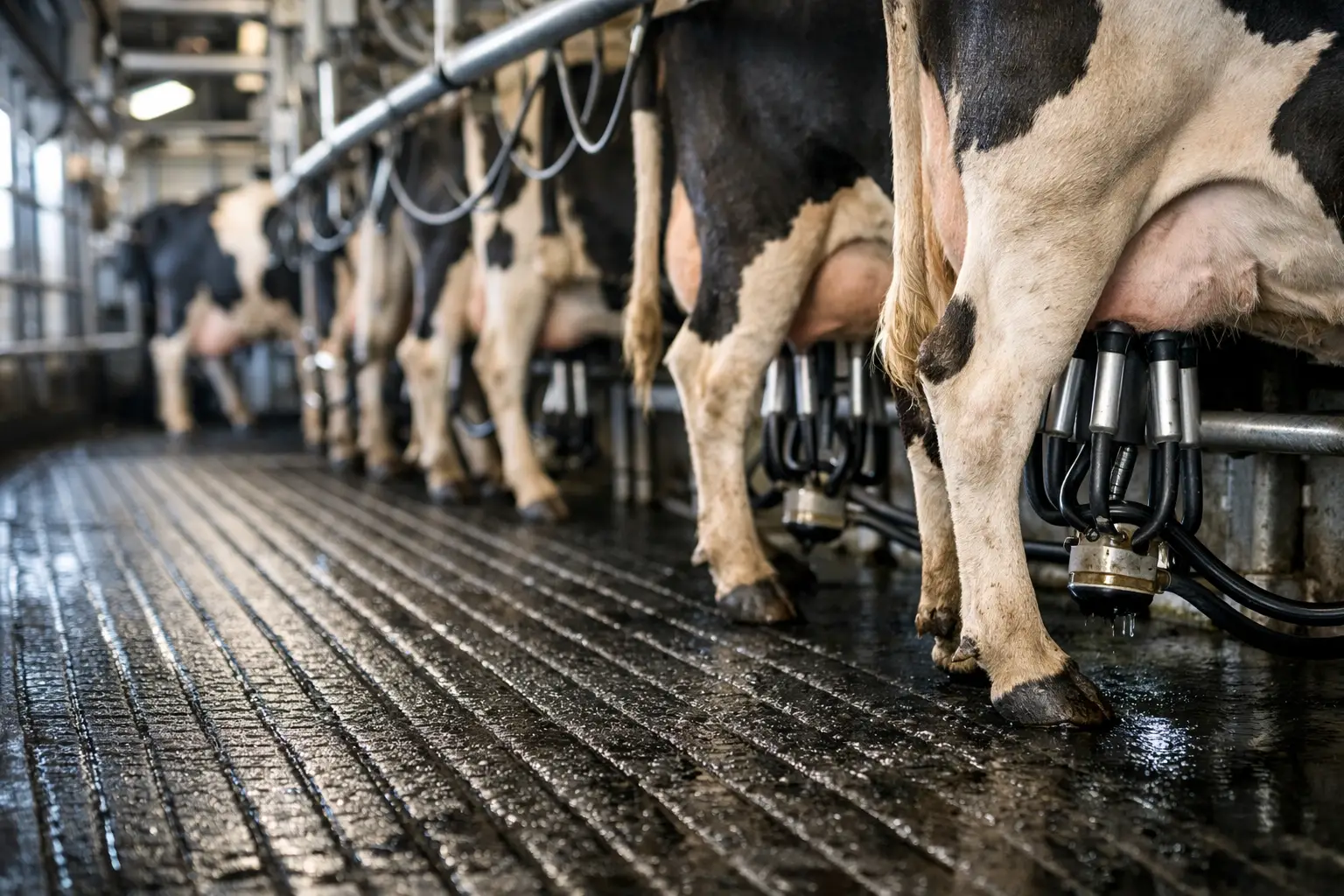
A cow that hesitates at the parlour entrance, spreads her stance on wet concrete or rushes to regain balance is telling you something about the floor. Knowing how to improve milking parlour traction is not just about preventing a fall. It is about protecting hoof health, keeping cows moving calmly and reducing avoidable pressure on staff during every milking.
Concrete in and around a parlour faces constant punishment. It carries heavy stock traffic, slurry, water, cleaning chemicals and machinery use, often several times a day. A surface that was once safe can become polished, worn, uneven or poorly drained. The result is a higher risk of slips, lameness and disrupted cow flow.
The right solution depends on why the surface is slippery in the first place. Good traction comes from a practical combination of surface texture, drainage, maintenance and stock handling – not from one quick fix.
Start by finding where traction is being lost
Walk the full cow route when the parlour is operating, not only when it is clean and dry. Look closely at the collecting yard, entry race, backing gate area, parlour entry and exit, turning points, platform edges and any return lanes. These are the places where cows change direction, slow down, bunch up or put extra force through their feet.
Watch for telltale signs: cows taking short steps, stopping before a turn, holding their heads low, slipping, or avoiding a particular patch of concrete. Also look for a glossy finish, standing water, slurry build-up, worn grooves, cracked sections and areas that have been patched unevenly.
A floor may look rough enough from a standing position but still offer poor grip under a wet hoof. Conversely, a very aggressive surface can create excessive hoof wear if it is used across a high-traffic area. This is why a proper assessment needs to consider the location, traffic volume, gradient, drainage and the condition of the concrete together.
How to improve milking parlour traction with surface profiling
When sound concrete has become smooth, professional surface profiling is often the most effective long-term answer. The aim is to create a consistent, slip-resistant texture that gives cows confidence underfoot while remaining practical to wash down and maintain.
Concrete grooving for directional grip
Concrete grooving creates channels in the slab that help hooves gain purchase and give water and slurry a path to move away. Groove direction matters. On straight approaches, grooves are generally positioned to support forward movement and reduce the chance of slipping. In turning areas, the pattern needs to account for the sideways forces created as cows pivot.
Depth, spacing and consistency are equally important. Grooves that are too shallow may wear quickly or provide little benefit. Grooves that are too sharp, uneven or poorly spaced can be harder on hooves and more difficult to clean. Specialist grooving is designed for livestock movement, rather than treating the job like a standard concrete-cutting task.
Bush hammering for broad, even texture
Bush hammering mechanically roughens the surface to produce a uniform textured finish. It can be particularly useful where a broad area has become polished, such as a collecting yard, exit lane or a section of parlour concrete with widespread traction loss.
This method is not a substitute for correcting poor drainage or damaged concrete, but it can restore grip without removing and replacing an otherwise sound slab. The final finish should suit the area. Cow movement zones need enough texture for reliable footing without becoming unnecessarily abrasive.
Choose the method for the location
There is no single pattern that suits every part of a dairy operation. Grooving may be the better fit for a known slip zone or directional race, while bush hammering can suit a larger polished area. Some farms need both, particularly where the entry, platform exit and yard each present different conditions.
The goal is controlled traction from the point cows leave the yard through to where they return to pasture. Treating only the obvious slip point can leave another weak area waiting to cause trouble.
Fix drainage before water becomes the problem
Water is one of the biggest reasons parlour surfaces become unsafe. Even well-profiled concrete will struggle if water, wash-down effluent or slurry sits across the cow path. Ponding also encourages contamination build-up, making the surface slicker and increasing cleaning time.
Check whether water is draining where it should. A shallow low spot, damaged drain, blocked channel or poor fall can direct water straight into a high-traffic area. Pay particular attention to transitions between old and new concrete, drain covers, platform exits and areas near hoses or wash-down points.
Repairs may involve restoring the fall, addressing low spots, repairing damaged channels or replacing broken concrete around drainage points. The best approach depends on the slab condition and how the parlour is used. A small repair made in the right place can prevent repeated cleaning, slipping and deterioration across a larger area.
Keep drains clear as part of normal maintenance. If effluent and debris are allowed to build up, traction work cannot perform as intended.
Repair damaged concrete promptly
Cracks, broken edges and failing patches affect more than appearance. They can hold water and manure, create trip points and make cleaning less effective. Over time, hoof traffic and machinery will continue to break down weak concrete, especially at thresholds, corners and areas exposed to scraper traffic.
A repair should leave a level, durable transition with the surrounding slab. Quick patch jobs that sit proud of the floor or wear away after a season can become another hazard. Where repairs are needed in a high-traffic cow zone, the finished surface should also match the surrounding traction treatment.
It is worth addressing damage while it is localised. Replacing a small failing section is generally less disruptive than waiting until the slab has deteriorated across a major parlour route.
Improve cow flow as well as the concrete
Floor traction is closely tied to what happens above the surface. If cows are being pushed too hard, crowded tightly at an entry or forced through sharp turns, even a well-textured floor has to work harder. Calm, steady movement reduces sudden loading through the hoof and lowers the chance of a slip.
Review gate pressure, race width, turn design and any bottlenecks that cause cows to stop abruptly. Keep hoses, tools and other obstacles out of walking paths. During wash-down, make sure the cleaning routine does not leave a continuous film of slurry or detergent where cows are due to walk.
Hoof care also has a role. Overgrown, uneven or compromised hooves reduce stability, so traction improvements work best alongside a sound hoof-health programme. If lameness is already showing up in the herd, consider the flooring conditions as part of the investigation rather than treating each case in isolation.
Plan work around milking, not against it
Parlour flooring improvements need to be practical for the farm. The most suitable method may depend on whether work can be completed in sections, how quickly the area needs to return to service and whether night work can reduce disruption to milking routines.
Before engaging a contractor, ask how they will assess drainage, identify appropriate texture for each zone, manage dust and slurry, and leave the area safe for livestock. The cheapest surface treatment is not always the best value if it wears early, does not suit cow traffic or creates a rough finish that is difficult to maintain.
Happy Hoof approaches traction as a livestock safety and operational issue, with concrete grooving, bush hammering and repairs planned around the conditions on your farm. The best result is not simply rougher concrete. It is a durable surface that supports confident cow movement through every milking.
A useful next step is to inspect the parlour route during the next wet wash-down, when poor drainage and polished concrete are hardest to hide. The problem areas your cows avoid today are often the areas worth fixing before they become a lameness or injury event.